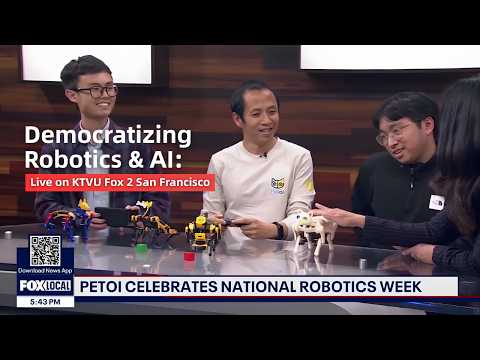

There’s some exciting robotics research coming out of universities across the globe, and we at Petoi are privileged to be a part of this story!
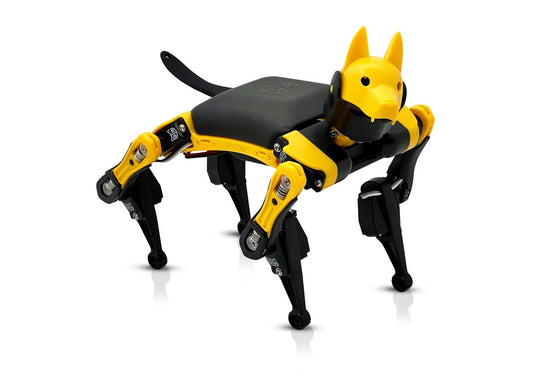
In the summer of 2023, undergraduate physics students, Deep Patel, Aidan Bannon and Willow Kohn from Haverford College, were using Petoi Bittle robot dogs as part of a robotics research project.

Their goal: to test how substrate properties and foot design influence power consumption, slippage, and walking speed in robots.
Working with Prof. Suzanne Amador Kane (Haverford College) and Prof. S. Tonia Hsieh (Temple University), they started by having two Petoi Bittle rodot dogs named Anubis and Horus walk endless miles on a circular track.

As you can see in the picture above, the group has attached a universal joint to constrain the programmable robot to the circular track, which features interchangeable textures, like sandpaper or plywood, a power tester to display power draw, and markers for computer vision tracking.
As summarized by It's a Dog's Life in the Biophysics Lab article:
“If I were to ask you, without any prior knowledge,” Patel questions, “if you think you'd be able to run faster on sandpaper with durable feet or a very slippery surface, say linoleum that's been freshly polished? What would you say?”
As anyone who has ever slid across their hardwood floors in socks can attest, the answer seems obvious: sandpaper. However, Patel and Kohn’s research points the other way. They say that the higher the friction ratio, the harder it is for the dogs to walk. As their work continues, they’re tweaking the gait of the open-source, programmable dogs.
The central question driving this research is: if quadrupedal robots are designed to mimic animals, why do they still rely on basic cylindrical feet? The goal is to explore whether bioinspired toes, claws, or hooves could unlock new capabilities to advance the next generation of robotic locomotion.
Here's the research poster that the Deep and Kohn presented at the Start Talking Science Conference at the Science History Institute in Philadelphia:


Both Deep Patel and Aidan Bannon have been featured on the Meet the Majors page of the Department of Physics and Astronomy at Haverford College.
Deep shared his experiences of working with Bittle:
I spent most of the summer working on creating an experimental testbed for our Petoi Bittle robot dog. My project ultimately aims to analyze frictional interactions between different robot feet and different substrates. Other groups worked on tracking spider legs using computers, understanding the biomechanics of sand-specialist lizard feet as they run across sand, and how spotted lanternfly's jump and land. Research involved learning new techniques, applying what I learned in my physics lab courses and doing some reading. It was a lot of fun!
You may wonder how physics is related to robotics & AI.
Physics majors understand the fundamental mechanics, dynamics, and control theory that govern how robots move and interact with their environment. Their training in mathematical modeling and sensor physics makes them naturally equipped to develop and optimize robotic systems. Robotics AI provides a practical application where physics students can apply theoretical knowledge to real-world problems.
Just FYI: Petoi founder/CEO and OpenCat Creator Dr. Li got his BS and Phd degrees in Physics. His physics background has powered him to develop innovative robotics systems.
Updates: Deep Patel and Willow Kohn won the Petoi's Choice Award of the OpenCat Robot Around the World Contest in 2024.

Interested in learning how Petoi transforms robotics education?
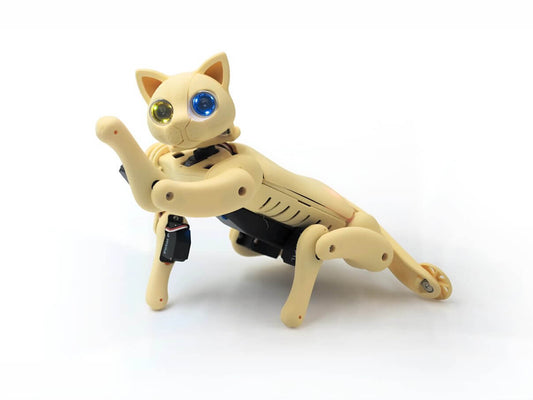
Watch middle school students enjoy the robotics camp at the Chinese University of Hong Kong - how to build & program Petoi Nybble robot cat!
To never miss an update on the latest and most useful updates, news, and tutorials, scroll down to subscribe to our newsletter!
Thanks for reading. Let us know what you think, & make sure to leave a comment below, and feel free to get in touch with us!