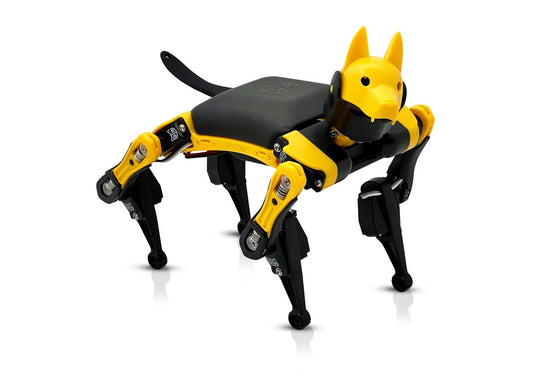

What makes a robot claw snap faster than a human blink? For Petoi's Bittle robot arm, the answer isn't a bigger motor — it's a spring. The Bittle robot arm's open claw mechanism uses a clutch-spring gear system inspired by the dragonfly nymph's jaw to snap shut in under 0.3 seconds, hold objects without drawing power, and even throw them on command. It's now available as an upgrade kit for Bittle or included in the Bittle X V2 package — and this is the full engineering story behind how it works.

Table of Contents
1. What Inspired the Petoi Bionic Claw Design?
Short answer: The Petoi open claw is biomimetically inspired by the dragonfly nymph's specialized jaw, which achieves predatory-speed capture through a unique mechanical degree of freedom — not raw muscle speed.

At Petoi, the engineering goal was to transform simple, affordable materials into a sophisticated mechanism that could perform actions previously impossible on a consumer-level robot platform. The dragonfly nymph's jaw extends and retracts with a spring-loaded snap — faster than any continuous motor could achieve at this scale. That biological principle became the core of the Petoi claw's design.
The result is a programmable robot arm that doesn't just grip — it captures, claps, and throws, making it suitable for robotics demonstrations, STEM education, and interactive play.
2. How Does the Bionic Claw Mechanism Work?
Short answer: The Petoi open claw uses a clutch-spring gear system — a sectored driving gear paired with a tension spring — to disengage servo power at the critical moment and let spring force snap the claw shut instantly. This can produce two full claps in under 0.3 seconds, far faster than servo rotation alone can achieve.
The mechanism has three integrated components working in sequence:
- Gear coupling: Both claw pieces connect via a standard synchronized gear structure, keeping movement mirrored and precise.
- Tension spring (passive grip): A spring holds the claws closed by default — no power required to maintain grip. This prevents servo overheating during extended hold operations, a critical advantage in open-source robotics projects running on limited power budgets.
- Sectored driving gear (the snap): The driving gear is divided into three sectors, each with three teeth and two missing teeth. The servo opens the claws until it reaches the missing-tooth gap — at that point, the driving force disengages and the tension spring snaps the claws shut instantly. This spring-reversal is what produces the snap speed impossible with servo rotation alone.

Patent status: Patent pending (as of most recent filing).
For example, at a 270° servo rotation range, the mechanism spreads gear wear across significantly more teeth than a standard 60° design, dramatically extending operational lifespan. Petoi stress-tested the clapping motion for 24 continuous hours before final production approval.
3. Key Specifications at a Glance
Use the table below to quickly reference Petoi open claw performance data:
| Specification | Value | Notes |
|---|---|---|
| Snap speed | < 0.3 seconds (2 claps) | Spring-reversal mechanism |
| Servo rotation range | 270° | vs. ~60° in standard designs |
| Stress test duration | 24 continuous hours | Petoi internal testing, 2024 |
| Calibration time | A few seconds | Fully automated via gyro |
| Drive type | 3× PWM alloy servos | Positional feedback retained |
| Grip at rest | Passive (spring-held) | No power is needed to hold |
| Manufacturing | Precision injection molding | After 100s of 3D-print iterations |
| Compatibility | Upgrade kit for Bittle, Bittle X V2 | |
| Weight capacity | 50 grams | Can hold more with customized coding |
| Arm reach/range | Arm length: 10 cm Pan: ±75° Tilt: 125° |
[FILL IN: reach in cm/inches] |
| Price (upgrade kit) | $69 | |
| Price (Bittle X V2+Arm) | $449 |
4. Why Did Petoi Switch from 3D Printing to Injection Molding?
Short answer: 3D printing was essential for rapid prototyping (hundreds of Fusion 360 iterations), but injection molding was necessary for the gear strength, consistency, and longevity required for a production-ready open-source robotics product.
The transition to injection molding delivers three concrete improvements:
- Durability: Injection-molded gear structures are significantly stronger than 3D-printed layered equivalents, reducing the risk of gear-tooth stripping under repeated high-speed snap loads.
- Reliability: Consistent dimensional tolerances ensure every unit performs identically — critical for auto-calibration accuracy.
- Longevity: The production design was stress-tested at 24 continuous hours of clapping motion before approval.
5. Why Does the Bittle Robot Arm Use a Precision Servo Instead of a Continuous Motor?
Short answer: A precision servo maintains positional feedback and allows exact control over the claw's opening angle — something a 360-degree continuous motor cannot provide. This preserves programmability and versatility across robotics applications.
The decision came down to a core trade-off: simplicity vs. control. A continuous rotation motor is mechanically simpler but gives up the ability to command and hold a specific angle. For a programmable robot arm used in STEM education and open-source projects, that level of control matters.
Here's why the 270° servo range specifically was chosen:
- A standard gear-and-claw structure limits servo rotation to under 60°, producing low torque and rapid gear wear.
- By engineering the gear ratio to use the full 270° range, Petoi spreads mechanical wear across far more gear teeth, extending lifespan significantly.
- The wider range also enables continuous claps within 0.3 seconds — a capability that would be impossible with a narrow-range design.
Programming note: The servo's positional feedback integrates with Bittle's open source control system OpenCat, allowing developers to command precise angles via Python, C++, and block coding.
6. How Does Auto-Calibration Work on the Bittle Robot Arm?
Short answer: The Bittle robot arm auto-calibrates by using its onboard gyroscope to detect vibration when the claws clap. It performs a coarse sweep, then 1-degree fine-angle steps, and saves the critical clap angle automatically — all in a few seconds, with no manual adjustment.
The calibration workflow runs in four steps:
- Pose — The arm raises to an elevated position to amplify vibration signals to the gyroscope.
- Coarse scan — The system sweeps through a range of angles; the gyroscope detects the first clap vibration event.
- Fine scan — The system steps through 1-degree increments around the detected clap point to pinpoint the exact critical angle.
- Save — The calibrated angle is saved automatically to the robot's onboard memory. No user intervention required.
Production note: This auto-calibration was specifically designed for mass production, replacing slow hand-calibration. Each unit self-calibrates in seconds on the production line. Users may use this feature to recalibrate the arm if needed.
7. How Does the Spring-Loaded Lifter Store and Release Energy?
Short answer: The Bittle arm replaces the standard parallelogram lifter's lower rigid edge with a tension spring, which stores potential energy as the arm lifts above head height — and releases it as kinetic energy when the arm reverses, enabling the claw to throw objects.
Standard parallelogram lifters use four rigid edges. Petoi's design replaces the lower edge with a tension spring for two specific benefits:
- Simpler assembly: Eliminates two screws and bearings from the build, reducing part count and assembly time.
- Energy storage and release: When the arm lifts above head height, the spring extends and stores energy. When the lifter reverses, that energy is released as additional forward speed — and when the claws open at that moment, the held object is thrown.
Real-world demo: The full claw mechanism — including the throw capability — was demonstrated at a recent electronics show using a micro:bit controller. All visitors were able to operate the arm within two minutes of practice.
8. Petoi Bionic Claw vs. Other Robot Grippers: Comparison
How does the Petoi open claw compare to the two most common alternative gripper designs used on programmable robot dogs?
| Feature | Petoi Robot Arm Kit | Standard Servo Gripper | Continuous Motor Gripper |
|---|---|---|---|
| Snap/close speed | < 0.3 sec (spring-assisted) | Servo-limited (~1–2 sec) | Motor-limited |
| Positional control | Full (270° range) | Partial | None |
| Passive grip (no power) | Yes (spring-held) | No | No |
| Servo overheating risk | Low (spring holds grip) | High (constant power) | Medium |
| Throw capability | Yes (spring lifter) | No | No |
| Auto-calibration | Yes (gyro-based) | Typically manual | N/A |
| Manufacturing | Injection molded | Varies | Varies |
9. Who Is This For? Use Cases and Applications
Short answer: The Petoi Bittle robot arm is designed for STEM educators, robotics hobbyists, makers, and developers who want an affordable, open-source programmable arm with real engineering depth.
STEM Education
The arm's intuitive control (demonstrated with micro:bit at shows) and accessible programming make it a strong choice for classroom robotics curricula. Students in grade four or above can explore biomimicry, gear mechanics, spring physics, and servo control in a single platform.
The open-source design and patent-pending clutch-spring mechanism make it a useful reference platform for researchers studying high-speed gripper design at low cost.
Maker & Hobbyist Projects
Developers can integrate the arm with Bittle's existing API to build custom pick-and-place routines, object-sorting bots, or interactive demonstrations.
Patrick Dhondt of the Netherlands, winner of Petoi Robotics Challenge and Showcase Contest - Fall 2025, showcased Bittle X V2+Arm robot dog taking on creative sports and games in a fun video which demonstrates impressive movement, adaptive gripping, and playful experiments with robotics abilities:
10. Frequently Asked Questions (FAQ)
Question: How fast does the Petoi open claw snap shut?
A: The Petoi open claw completes two full claps in under 0.3 seconds, achieved through a clutch-spring gear mechanism that bypasses servo rotation speed limits by using spring force for the closing stroke.
Question: Why does the Bittle robot arm use a precision servo instead of a continuous rotation motor?
A: A precision servo maintains positional feedback and allows control over the exact opening angle — something a 360-degree continuous motor cannot offer. The Bittle arm's servo rotates up to 270°, maximizing torque, lifespan, and programmability.
Question: Is the Petoi robot arm compatible with Bittle and Bittle X V2?
A: Yes. The open claw robot arm is available as an upgrade kit for existing Bittle programmable robot dogs, and is also included in the Bittle X V2+Arm package.
Question: How does the auto-calibration system work on the Petoi robot arm?
A: Calibration uses the onboard gyroscope to detect vibration during a coarse angle scan, then performs 1-degree fine-angle steps to find the precise clap angle, saving it automatically in seconds — no manual adjustment required.
Question: What programming languages and platforms does the Bittle robot arm support?
A: It supports Python, C++, and Scratch-like block coding. The coding environment can be run on Windows/Mac/Linux.
Question: What is the weight/payload capacity of the Petoi robot arm?
Answer: It can hold 50 grams or more with customized coding.
Question: What is the reach or working range of the Bittle robot arm?
Answer: Arm length: 10 cm; Pan: ±75 degrees; Tilt: 125 degrees.
Question: Can the claw pick up irregular or soft objects?
Answer: The claw has two coatings printed with soft material. It can pick up irregular shapes that are taller than 1mm.
Question: Does Petoi provide the STL or CAD files for their robot arm so I can 3D print a replacement or modification at home?
Answer: The arm is patent-pending and requires special parameters to print properly. We use injection molding to ensure it has the best strength and elasticity and lasts for a reasonable lifespan.
Question: How long does it take to assemble the robot arm upgrade kit?
The arm is preassembled. You only need to attach it to the robot's body and connect the wires. Then you will need to upload the firmware to support the arm's behavior. It takes about 10 minutes if everything goes right.
Question: Does the claw need to be recalibrated after reassembly or firmware updates?
A: We recommend recalibration.
Question: What is the price of the Bittle robot arm upgrade kit?
A: It's starting at $69 for the arm upgrade kit. We offer upgrade discounts to existing customers.
11. How to Get the Petoi Robot Arm
The Petoi open claw robot arm is available in two configurations:
- Upgrade kit for existing Bittle owners — adds the open claw arm to your current Bittle robot dog.
- Bittle X V2 + Arm bundle — the complete package for those starting fresh.
12. About the Author
Rongzhong Li is the founder & CEO at Petoi, and the creator of OpenCat, the most starred open source quadruped robotics framework on GitHub. He has 10+ years of experience in open-source robotics hardware and software. He designs and develops all the robots from Petoi.